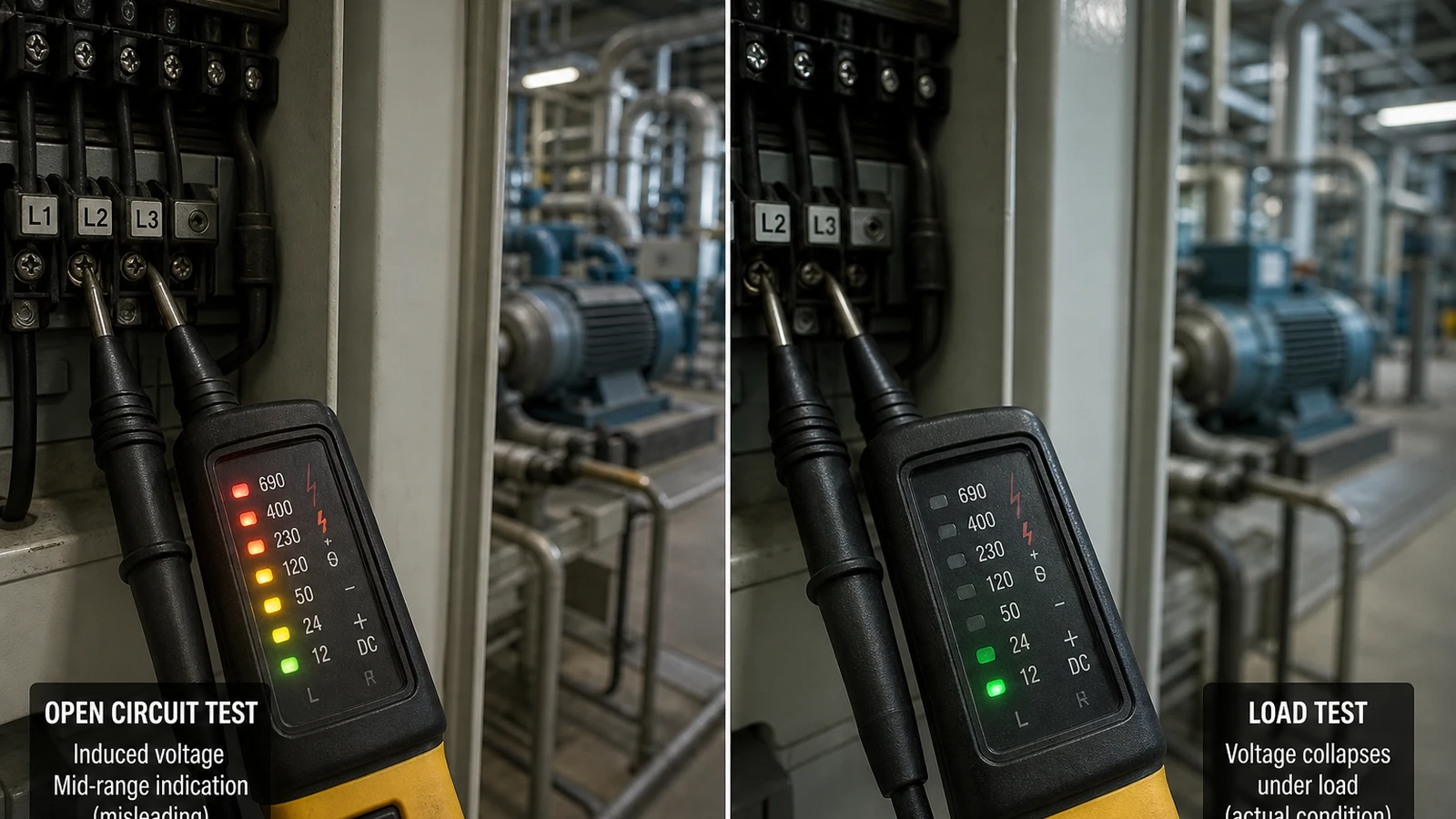
Ghost Voltage And Two-Pole Testers In UK Homes
Short answer: ghost voltage is a misleading voltage indication that can appear on disconnected or lightly coupled conductors. A suitable two-pole tester may help distinguish it from a real supply, but unexpected readings should still be treated carefully.
Electrical testing is useful only when the tester, leads and method match the circuit. For UK mains work, safe isolation and competence matter more than getting a quick indication.
What ghost voltage can look like
An RCD responds to current imbalance between live and neutral. If testing creates an unexpected path to earth, or if a tester or lead is damaged, the device may trip instead of giving a normal reading.
Why high-impedance testers can confuse the picture
Two-pole testers, proving units, continuity functions and battery-assisted displays do different jobs. A voltage indication does not automatically prove that continuity, polarity or safe isolation checks are valid.
How a two-pole tester may help
Prove the tester before and after the check using a known live source or proving unit. A weak battery, damaged probe tip or poor lead connection can make a safe-looking result unreliable.
Do not assume a circuit is safe from one reading
CAT ratings describe the installation environment the tester is designed to withstand. The tester body, probes and leads all need to suit the circuit; a rating on one part does not rescue an unsuitable setup.
When unusual voltage readings need an electrician
Do not bypass an RCD, hold probes on a tripping circuit or repeat a live test to see what happens. Stop and use a qualified electrician when readings or protective devices behave unexpectedly.
Quick buying checklist
- Check the tester rating and lead condition.
- Prove the tester before and after use.
- Use continuity only on isolated circuits.
- Treat unexpected RCD trips as a fault signal.
- Use a qualified electrician for live mains uncertainty.
FAQ
Is this a job for a beginner?
Some visual checks are beginner-friendly, but electrical, LPG, buried-service and car diagnostic work can become unsafe quickly. Stay with inspection-level checks unless you are competent and have the right equipment.
What should I check before buying a tool or accessory?
Check the product instructions, the job you actually need to do, and whether the item matches your vehicle, appliance, clothing use, garden system, brew-day setup or burner arrangement. If the fit or rating is unclear, pause rather than guessing.
Final buying advice
A voltage tester should make a controlled check clearer, not encourage repeated live experimentation. If the tester, circuit or result is uncertain, stop and verify safely.